
Kula, A’apueo, Maui
The A’apueo area in the Kula district (Upcountry Maui, western slope of Haleakalā) sits in a mid- to high-elevation agricultural mosaic of orchards, pastureland, windbreak forests, and scattered gulch vegetation. The climate is cooler and wind-exposed, with seasonal rainfall patterns that strongly influence bloom cycles. Honey production here is shaped by a mix of planted windbreak trees, orchard species, and persistent wild flowering plants, producing a complex, aromatic, light-to-medium honey.
Character of Kula, A'apueo Honey
Honey from the Makaʻehu region of Kula is typically light to medium amber with a bright, layered aromatic profile. It reflects the interaction of orchard agriculture, windbreak forestry, and upland pasture ecosystems.
Common tasting notes include silky oak floral spice, eucalyptus herbal tones, macadamia sweetness, and avocado softness. The result is a honey that is cooler, cleaner, and more aromatic than lowland Maui honeys, with a clear expression of Upcountry ecology.
Overall, A’apueo (Kula) honey can be understood as a wind-exposed upland orchard–windbreak honey system, where introduced trees and cultivated species together define a distinctive and highly variable honey character.


Taste the Forest
Top Honey-Producing Plants of the A'apueo (Kula District) Region, Maui. Our bees are thriving on these sources of nourishment.
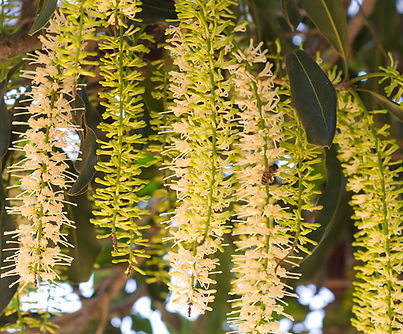
Macadamia
Scientific Name: Macadamia integrifolia
Common Name: Macadamia Nut Tree
Macadamia trees—both in remnants of older orchards and scattered homestead plantings—contribute high-quality nectar during their flowering period.
Bloom Season: Spring.
Contribution to Honey:
-
High-quality seasonal nectar source
-
Produces light, delicate honey
-
Soft nutty, floral sweetness
-
Enhances smoothness and complexity in blends
Ecological Notes:
Even isolated trees can contribute noticeably to honey flavor during peak bloom, making macadamia an important upland floral component.

Avocado
Scientific Name: Persea americana
Common Name: Avocado
Avocado trees are widely planted in residential and small agricultural properties throughout Kula. Their dense flowering provides excellent nectar and pollen for bees during cooler months.
Bloom Season: Winter through spring.
Contribution to Honey:
-
Reliable nectar and pollen source
-
Produces smooth, mild, light honey
-
Subtle buttery and floral undertones
-
Supports colony buildup before spring flows
Ecological Notes:
Because avocado trees are scattered throughout the landscape, they create a distributed nectar network across the Kula region.

Silky Oak
Scientific Name: Grevillea robusta
Common Name: Silky Oak
Silky Oak is one of the most important nectar trees in Upcountry Maui, especially in Kula’s agricultural and windbreak landscapes. When in full bloom, its bright orange flower clusters create a strong and highly attractive nectar source for honey bees.
Bloom Season: Spring through early summer.
Contribution to Honey:
-
High-volume nectar producer during bloom events
-
Produces light to medium amber honey
-
Distinct floral, slightly spicy, honeyed aroma
-
Can strongly define seasonal honey crops
Ecological Notes:
Originally introduced as a windbreak tree, Silky Oak has become naturalized across parts of Kula’s ranchlands and homesteads, making it one of the most reliable large-scale nectar sources in the region.

Eucalyptus
Scientific Name: Eucalyptus robusta, Eucalyptus saligna, and related species
Common Name: Eucalyptus
Eucalyptus remains one of the dominant nectar-producing trees in Upcountry Maui. Many stands were planted historically for forestry and windbreak purposes and now form semi-wild groves throughout Kula.
Bloom Season: Variable; often late winter through summer depending on species.
Contribution to Honey:
-
Major regional nectar backbone
-
Produces medium amber honey
-
Herbal, menthol-like, slightly medicinal flavor notes
-
Provides consistent forage between orchard blooms
Ecological Notes:
Eucalyptus is especially important during seasonal gaps when agricultural bloom is minimal, stabilizing colony food supply.